
Part 1 – Yamashima Sensei’s Aikido Journey
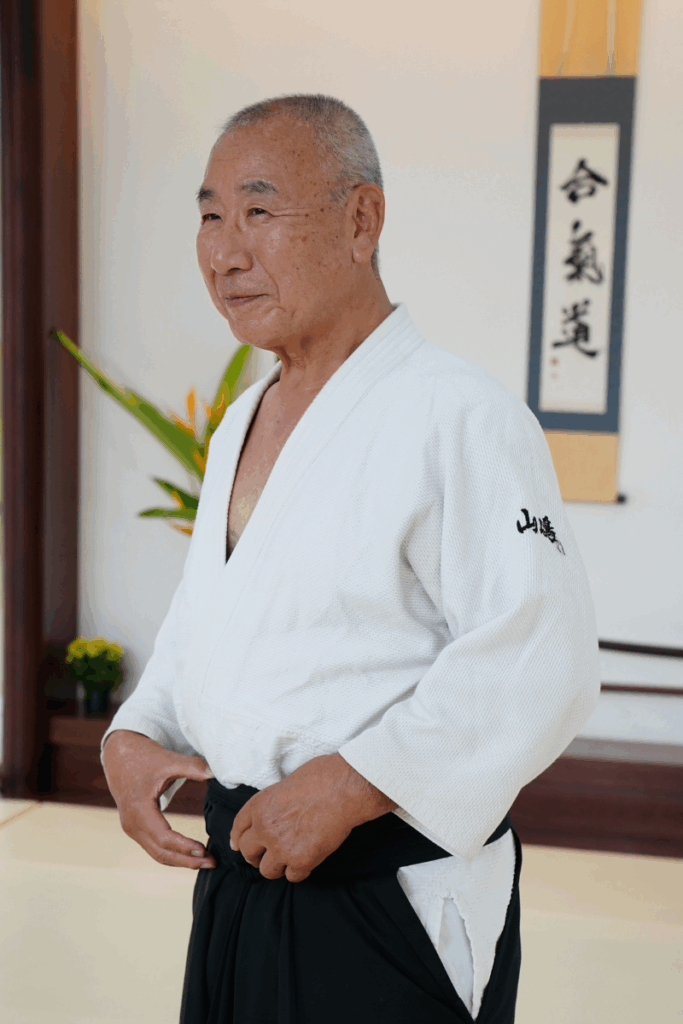
Q: Sensei, can you share your Aikido journey with us?
A: Early Training and Influences
My journey in Aikido began at the Hosei University Aikido Club, where I trained under Arikawa Sensei and Yamada Sensei. After graduating, I continued my practice at the Aikido club of my workplace, where I had the opportunity to learn from Saotome Sensei, who at the time was deeply influenced by the teachings of Yamaguchi Sensei.
As I progressed in my training, I was also fortunate to encounter the teachings of other remarkable instructors at Hombu Dojo. Osawa Sensei left a lasting impression among them — his Aikido was steady, grounded, and powerful. I regularly attended his early morning keiko and special seminars, where I could feel the depth of his practice. Masuda Sensei’s Aikido, on the other hand, was intellectually rich and equally strong in both spirit and technique. His analytical approach gave me new perspectives on the theoretical foundations of movement and connection.
Above all, I hold deep respect for Ueshiba Kisshomaru Sensei. Without his dedication to sharing Aikido with the public, we would not have the opportunity to practice it today. His contribution extended far beyond administration — it was the transmission of a living spirit.
Establishing Chiyoda-ku Aikido Club
During that period, Saotome Sensei recognized Chiyoda-ku Sports Center as a potential training space and asked me to start a new club there (in 1972). Initially, it wasn’t an official class but a gathering of graduates from the University Aikido Club, the Tokyo Metropolitan Government Aikido Club, and Tokyo Fire Department Aikido Club members.
Most of us were between 20 and 30, and I was 26 then. Because we were young and full of energy, we lacked proper technique and mainly relied on strength—it was almost like fighting Aikido.
Meeting Yamaguchi Sensei
When I turned 30, Saotome Sensei moved to the United States after receiving an invitation from a group in Florida to teach Aikido. Before leaving, he told me, “I have asked Yamaguchi Sensei to teach at Chiyoda Club.” So, I went to Hombu Dojo to meet Yamaguchi Sensei, and he accepted. That was when I officially started training with him.
When I was a university student, my sempai mentioned that an excellent teacher had just returned from Burma (now Myanmar). That teacher was Yamaguchi Sensei. I did not actively seek him out, but as fate would have it, he became my teacher naturally.
Reflections on Training under Arikawa Sensei
At first, I did not know how to take ukemi for Yamaguchi Sensei. My experience with Arikawa Sensei was very different. Training under Arikawa Sensei felt like a fight rather than proper ukemi practice. He had a background in karate, and his knees were injured from years of intense practice. He trained very hard and even lifted weights.
He didn’t rely solely on Koshi but engaged his entire body, making his Aikido powerful and physically demanding. If you didn’t make large movements, you could easily get injured. His techniques were powerful—if the uke resisted during Shiho-nage, their elbow could be broken unless they took a big ukemi.
At that time, we believed strength was essential, and every practice session felt like a battle. But I was happy. (He smiles)
Q: How was it when you started training under Yamaguchi Sensei?
A: When Yamaguchi Sensei arrived at Chiyoda and observed our training, he said, “This is not good, not good at all.” One time, while training with him, he told me, ‘I heard you trained under Saotome Sensei, so I expected you to be much better—but you are not.’ My movements were still rough and lacked refinement,” Yamashima Sensei said with a smile.
After Yamaguchi Sensei passed away, Masuda Sensei from Hombu Dojo took over. He was also a strong man.
Q: How did Yamaguchi Sensei transform the practice at Chiyoda?
A: Initially, none of us knew how to take ukemi properly. However, we gradually started to understand his style. It took us about two to three years to adapt and nearly 20 years to refine it.
Japan was experiencing rapid economic growth at the time, and many people were eager to train. This environment fostered flexibility and adaptation, gradually transforming our bodies over time. Eventually, our movements became smoother and more refined.
Q: How has your body changed over time?
A: Training under Yamaguchi Sensei fundamentally transformed the way my body moved. At that time, I also practiced at Yamaguchi Sensei’s class every Monday night at Hombu Dojo after work and took Uke for him. He frequently corrected my form, making my body more flexible. Over time, I started to understand his way of moving.
After years of practicing with him, I became more fluid. My training with him lasted over 20 years—those were happy days. (He smiles)
Q: Would you say Yamaguchi Sensei was the most influential teacher in your Aikido?
A: Yes, I think so.
Q: Having trained as Yamaguchi Sensei's uke for many years, do you feel that experience helped you better understand his Aikido?
A: Yes, but Yamaguchi Sensei had many students, and while everyone aspired to be like him, it was far from easy. His approach was profound, and only a handful of students in Chiyoda truly grasped its essence. (He smiles again)