
Part 4 – Kenjutsu, Body Movement, and Aikido Philosophy
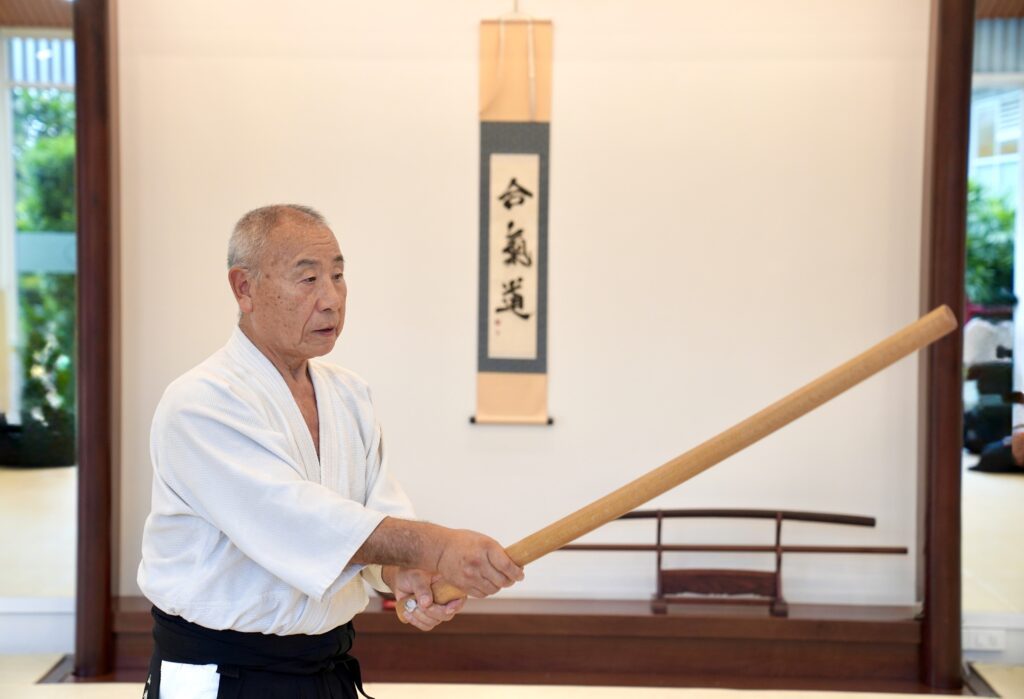
Q: Yamaguchi Sensei often used a bokken in training and demonstration. Do you think his understanding of Kenjutsu influenced his Aikido?
Yamaguchi Sensei didn’t formally study Kenjutsu. He was in the navy, so maybe he practiced it a little during that time. Many of his students practiced Kashima Shinto Ryu, and he observed them closely—learning from their movements and gradually integrating some of that into his Aikido.
I watched how he used the bokken. It was a more modern style, which relied heavily on wrist power—not the traditional way. Because I practice Shinkage Ryu, I can recognize how someone uses the sword differently. In traditional styles, the movement comes from the center—especially from the koshi, not just the arms or wrists.
That understanding changes how you move in Aikido, too. Once you feel the connection through the center, everything becomes more natural. So, even though he didn’t study Kenjutsu deeply, I think Yamaguchi Sensei found his own way to bring that spirit into his Aikido.
Q: Do Kenjutsu and Aikido share the same principles?
Yes, the body movement principles are the same. If someone studies traditional Kenjutsu, they should understand this.
When you know how to use your body with a sword, you start to appreciate taijutsu—the body’s movement. And when you truly feel your body, you begin to recognize your center. Then, instead of relying on your hands, you can move with your whole body.
Once you understand this principle, your Aikido will improve significantly. But many people don’t realize it.
However, it’s not just about the hands or body—you also have to train your mind. A calm, sensitive mind makes the body quieter and more focused. Everything becomes connected as one.
So the real question is: how can we use the entire human body and mind together—to reach the uke’s center without using power?
At Chiyoda-ku, everyone is always thinking about this. That’s why they’re good at Aikido. If you keep thinking like this, your Aikido will naturally change—step by step.
Q: Do you think it is necessary to practice Kenjutsu to understand Aikido better?
It’s not necessary to practice Kenjutsu, but it helps. Even simple suburi and understanding how to use your koshi can improve your Aikido. In Kenjutsu, we have a sword, so the distance is different. In Aikido, the contact is closer—but the principle is the same. You can learn how to use koshi from Aikido, but for someone who already knows Kenjutsu, it’s easier to understand Aikido.
Also, you should not rely on your hands. I saw many people doing Aikido using only their hands—wasting power. You must concentrate your power, practice Kimochi, and move from your center. That’s how you improve in Aikido.
Many people don’t understand, “What is Aikido?” At the beginning, I also practiced what looked like Aikido—but it was not really Aikido. After 10 or 20 years, I started to understand more. I always ask myself, “How should I do Aikido?”I stopped using my hands and shoulders too much, and instead, I constantly check my connection—“Am I using my center?” Before, I just did techniques. Now, I realize that only when moving from the center, the movements become smooth—and Aikido becomes more interesting.
The most important way to practice is to move naturally, to feel what you are doing, what kind of attack your partner gives, and how they resist. In my view, Aikido is like a tree. The branches and leaves are strong but flexible, and the roots are deep and stable. They receive the power—and finally, the whole tree responds and throws. That’s the image I always carry with me.
Q: What advice would you give to long-time Aikido practitioners who feel they are no longer improving?
A:
Whenever I practiced with Yamaguchi Sensei, I asked myself, “How should I do it?” Sometimes, observing his movements, I learned something new, so I changed each time. Yamaguchi Sensei had O Sensei’s feeling. He always considered how to follow O Sensei’s way.
Yamaguchi Sensei didn’t remember through words but through his body. That’s why he kept changing and improving. He once told me: “When I was 50 years old, my Aikido improved greatly, and I thought I finally understood. But now that I’m 80… I truly understand Aikido—but it’s too late.”
I think Yamaguchi Sensei was not just teaching students—he was always searching and trying new things in every practice. He was constantly studying and practicing his own Aikido.
When you teach Aikido, you must also begin your own study. If not, you will not change. Some people—especially those with high rank—only teach. But if they don’t study, they never evolve.
That’s a very important idea… I think.
Thank you very much, Sensei!
This conversation has offered us profound insights into your Aikido journey, your understanding of its principles, and the spirit of lifelong learning and refinement. Your reflections will no doubt inspire and guide many Aikidoka in Vietnam and around the world.
We are deeply grateful for your time and generosity in sharing your experience with us.